
 Mental Health & Resilience
 Leadership Development
 Physical Wellbeing
 Workplace Culture
Meditation Research for Workplace Wellbeing Programs
This page summarises workplace meditation and mindfulness research, noting where evidence is strong or emerging, and the key considerations for HR and wellbeing leaders.
Tell us what your team needs
Complete the form and we’ll recommend the most suitable service, format or next step for your organisation.
No obligation. We respond to all enquiries within 12 hours.
What the research actually shows about meditation at work
Bottom line: For HR leaders, the evidence indicates that workplace meditation yields moderate, consistent reductions in employee stress, along with small-to-moderate gains in focus and sleep. There are also meaningful improvements in burnout and job satisfaction, especially in high-pressure teams. Meditation is a valuable addition to wellbeing initiatives, but it should not replace necessary actions to address workloads, leadership behaviours, or organisational psychosocial risks.
If you are considering workplace meditation, ask where the evidence is strongest, what outcomes are realistic, and how it complements your overall wellbeing strategy, not just whether it works.

What meditation means in research
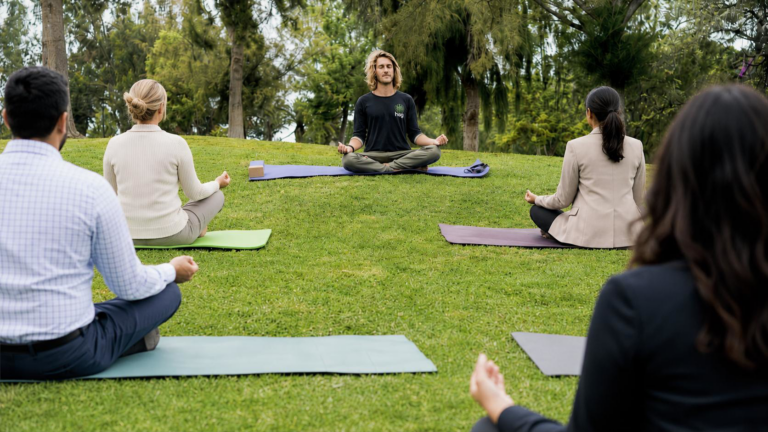
Meditation, in workplace research, refers to a family of attention-training practices. The two most-studied traditions are mindfulness meditation (training in non-judgmental present-moment awareness through breath, body scan, and the observation of thought) and loving-kindness meditation (which cultivates compassion toward self and others). Most workplace programs draw on clinically tested protocols, including Mindfulness-Based Stress Reduction (MBSR), an 8-week curriculum developed by Jon Kabat-Zinn in the 1970s, and Mindfulness-Based Cognitive Therapy (MBCT). Holistic Services Group draws on these traditions in delivering corporate meditation sessions, alongside Australian-developed approaches such as the “mental silence” method studied by Manocha and colleagues in Sydney.
What the evidence shows at a glance
Workplace stress
Workplace-delivered mindfulness training produces moderate, replicable reductions in perceived stress across desk-based, healthcare, frontline and academic workforces (Bartlett et al., 2019; Vonderlin et al., 2020).
Anxiety and psychological distress
Workplace meta-analyses report meaningful reductions in anxiety and general distress, with effect sizes comparable to or larger than those reported for stress (Bartlett et al., 2019; Vonderlin et al., 2020).
Focus and cognitive performance
A meta-analysis of 111 randomised controlled trials found that mindfulness produces small-to-moderate benefits in executive attention, working memory accuracy, and sustained attention. Instructor-led programs outperformed self-guided apps (Zainal & Newman, 2024).
Sleep
Workplace meditation produces small-to-moderate improvements in sleep quality, particularly in workers reporting elevated stress (Rusch et al., 2019; Bartlett et al., 2019).
Where workplace meditation is most useful
Meditation is most useful when organisations want to support:
- Stress regulation and emotional self-awareness
- Focus, attention and mental clarity
- Recovery during high-pressure work periods
- Sleep and nervous system regulation
- Broader resilience and mental wellbeing programs
- Wellbeing days, Mental Health Month, R U OK? Day or ongoing annual wellbeing calendars
Meditation is best positioned as part of a comprehensive wellbeing approach rather than a standalone response to issues such as high workloads, unsupportive leadership, bullying, lack of role clarity, or unmanaged psychosocial hazards. These challenges require targeted, higher-level organisational interventions.
The strongest research reviews
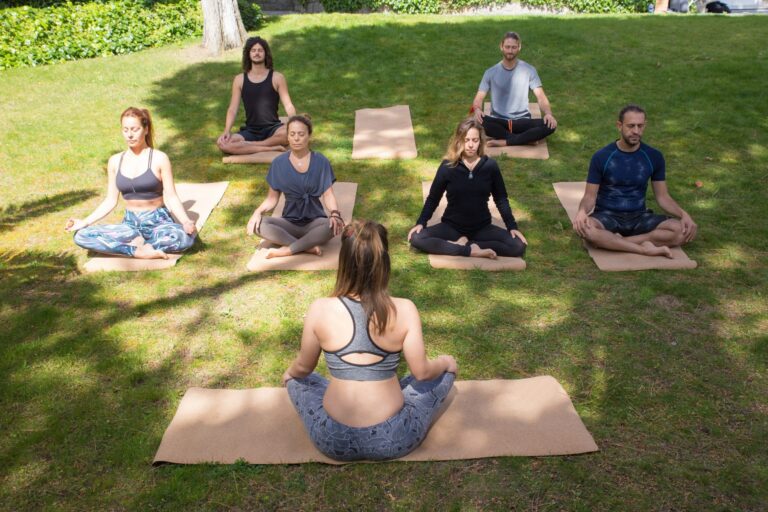
Three systematic reviews carry the most weight in the current evidence base.
Goyal et al., 2014 (JAMA Internal Medicine)
Scope: 47 RCTs, 3,515 participants across clinical and general populations.
Key finding: Moderate evidence of improvement in anxiety, depression and pain at 8 weeks; smaller effects on stress and mental-health-related quality of life.
Why it matters: The landmark clinical synthesis and the most-cited reference point when assessing meditation’s evidence base.
Bartlett et al., 2019 (J. Occupational Health Psychology)
Scope: 23 RCTs of mindfulness training delivered in workplace settings.
Key finding: Significant effects for mindfulness (g = 0.45), stress (g = 0.56), anxiety (g = 0.62), distress (g = 0.69), wellbeing (g = 0.46) and sleep (g = 0.26).
Why it matters: The most workplace-relevant meta-analysis. Every study was workplace-delivered; effect sizes are meaningful, not transformational.
See: Bartlett et al., 2019 workplace mindfulness meta-analysis.
Vonderlin et al., 2020 (Mindfulness)
Scope: 56 RCTs of mindfulness-based programs across diverse workplaces.
Key finding: Reductions in stress, burnout, mental distress and somatic complaints; improvements in mindfulness, wellbeing, compassion and job satisfaction.
Why it matters: Broadens the workplace evidence base into burnout, satisfaction and somatic symptoms.
Research by workplace outcome
Workplace stress
Manocha et al., 2011, Sydney, Australia: 178 full-time workers in an eight-week controlled trial showed significant improvement in psychological strain and depression-dejection, making this a foundational Australian workplace meditation study. See: Manocha et al., 2011 study.
Vainre et al., 2025, Stress and Health: The latest meta-analysis confirmed positive effects of mindfulness on contextual and adaptive work performance, with task performance results being mixed.
Heckenberg et al., 2018, Journal of Psychosomatic Research: This systematic review found consistent improvements in physiological stress markers and self-reported stress reductions from workplace mindfulness programs.
Anxiety and worry
Hoge et al., 2018, Massachusetts General Hospital: Adults with generalised anxiety disorder in MBSR programs showed greater biological and self-reported improvements compared to controls.
Shahar et al., 2015: Loving-kindness meditation led to sustained reductions in self-criticism and depressive symptoms, offering relevance for perfectionism and burnout.
Focus, attention and cognitive performance
Zainal & Newman, 2024, Health Psychology Review: The largest synthesis to date: 111 randomised controlled trials. Found small-to-moderate improvements across global cognition and multiple subdomains, including executive attention, working memory, sustained attention, inhibition and shifting. Notably, instructor-led face-to-face programs produced larger effects than self-guided digital programs.
Mirabito & Verhaeghen, 2023, Journals of Gerontology: A meta-analysis of 30 RCTs in older adults confirms that mindfulness improves attention, irrespective of age, intervention length, or gender.
Sleep and recovery
Rusch et al., 2019, Annals of the New York Academy of Sciences: Systematic review and meta-analysis showing moderate improvements in sleep quality compared with non-specific active controls, with benefits maintained at follow-up.
Chan et al., 2022, World Journal of Psychiatry: Meta-analysis of sleep outcomes among people with common mental disorders confirms meaningful sleep improvements in this group.
What meditation should not be used for
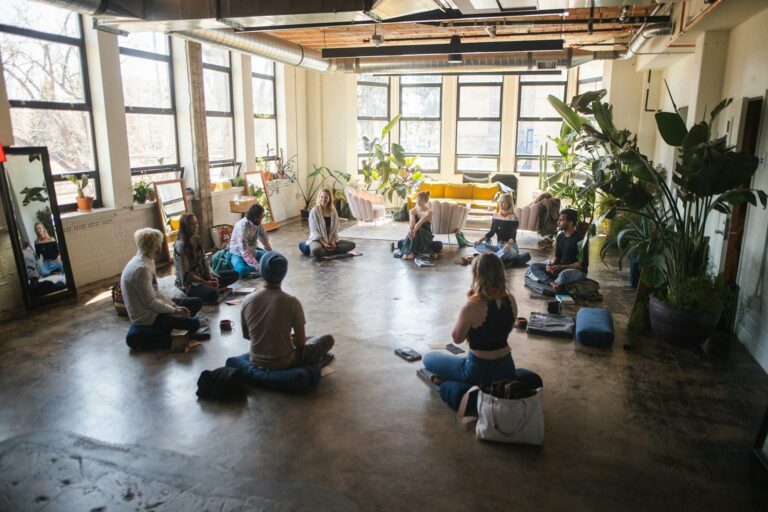
Meditation can support stress management, focus, and wellbeing. It is not sufficient as a replacement for structural solutions to broader workplace challenges. It should not be used as a substitute for:
- Manageable workloads
- Respectful leadership behaviour
- Appropriate staffing levels
- Psychosocial hazard controls
- Access to clinical or EAP support when needed
This matters in Australia, where employers have explicit obligations under amended Work Health and Safety Regulations to identify, assess and control psychosocial hazards using the same hierarchy of controls applied to physical hazards (Safe Work Australia, Model Code of Practice, 2022). Individual coping tools, including meditation, do not meet those obligations on their own.
When integrated thoughtfully, meditation enhances a broader wellbeing strategy. It cannot replace the foundational organisational interventions that compliance requires.
How HSG translates the evidence into workplace sessions
Holistic Services Group has delivered workplace wellbeing services since 2003. HSG translates the research into practical workplace formats: introductory meditation sessions, wellbeing-day experiences, lunchtime mindfulness sessions, and structured multi-week programs. Sessions are delivered by specialist facilitators and adapted for corporate environments, where time, psychological safety and accessibility matter.
Research indicates that long-term engagement produces the most effective outcomes. HR and wellbeing leaders are encouraged to embed meditation into a structured program or wellbeing calendar rather than rely on occasional workshops. Sessions are delivered onsite across Sydney, Melbourne, Brisbane, Perth, Adelaide, Canberra, regional areas nationally and New Zealand, and virtually across Australia, New Zealand and the Asia-Pacific.
What clients say
Our Institute is full of busy researchers and operational support staff, so when we saw the Mindfulness for Busy People workshop, we knew it would be a great fit. Dana was incredible at engaging participants, and ensured everyone left the session with something to take away, whether that was a new way to practice mindfulness or an interesting story to ponder on. We would definitely book HSG and Dana again for future office workshops!
Alex Hide
The Heart Research Institute

Explore meditation sessions for your team.
See how HSG turns this evidence into practical, facilitated workplace sessions.

Frequently asked questions
In aggregate, yes, with caveats. Meta-analyses of workplace-delivered mindfulness training consistently show moderate reductions in perceived stress, anxiety and psychological distress (Bartlett et al., 2019; Vonderlin et al., 2020). The evidence is strongest for programs delivered by qualified facilitators, with sufficient session frequency, and where participants engage with home practice between sessions.
Most workplace research uses programs in the four-to-eight-week range, with 30–90 minutes of weekly facilitated practice plus shorter daily exercises. Shorter formats (single sessions, lunchtime sits, wellbeing-day workshops) produce in-session benefits and good participation, but less durable change. The 2024 Zainal & Newman meta-analysis found instructor-led programs produced larger effects than self-guided apps, particularly for attention and cognitive outcomes.
Workplace mindfulness is one of the more extensively studied individual-level wellbeing interventions, particularly for stress, anxiety, distress and attention. It is well-suited to organisations looking for a low-risk, well-evidenced intervention that complements broader mental health and resilience work. It is not a substitute for structural changes to workload, supervision or job design, which are required under Australia’s psychosocial risk regulations.
Meditation sits comfortably alongside mental health training, leadership development, ergonomics and culture work, and the workplace evidence base supports it as a complement rather than a stand-alone solution. Organisations seeing the strongest results typically embed meditation within a broader annual program. See Mental Health & Resilience and Workplace Wellness Programs for related services.
HSG delivers meditation sessions onsite across Sydney, Melbourne, Brisbane, Perth, Adelaide, Canberra and regional areas nationally. Virtual sessions are available nationwide and across the Asia-Pacific. Contact us to confirm availability in your location.
Trusted by 1,600+ organisations across Australia and Asia-Pacific
Supporting corporate, government, healthcare, education and not-for-profit sectors




























HSG has supported more than 1,600 organisations across corporate, government, healthcare, education and not-for-profit sectors, including Microsoft, Telstra, Commonwealth Bank, BHP, the Department of Defence, St Vincent’s, the University of Sydney, Deakin University, The Smith Family and headspace National Youth Mental Health Foundation.
Start the conversation
More than 1,600 organisations have trusted HSG to deliver practical workplace wellbeing programs across Australia. Tell us what your team needs, and we’ll help you identify the right next step.
We respond to all enquiries within 12 hours.