Mental Health & Resilience
 Leadership Development
 Physical Wellbeing
 Workplace Culture
What Should You Look for in a Corporate Massage Provider?

Table of contents
1. Qualified therapists who can work in business settings
2. A clear plan for insurance, consent, and safety
3. Scheduling that respects how work actually happens
4. The right massage type for the setting
5. Privacy and dignity for employees
6. Professional communication before and after
7. Quick booking checklist
8. Choosing a provider in Sydney
9. FAQs
Workplace massage can look simple from the outside. A chair, a therapist, a booking sheet. But in practice, the quality of the experience depends heavily on the provider. Poor planning, inconsistent therapists, and rushed delivery can turn a wellbeing initiative into a frustration. By the time an HR or People and Culture team books a workplace massage, the goal is rarely just relaxation. Teams may be under pressure. Employees may be sitting for long hours. Morale may need support. The organisation wants something staff can genuinely access during the workday, without creating disruption or discomfort. That is where provider choice makes all the difference.
To help guide your selection, consider these key points:
- Check therapist qualifications, insurance, and workplace experience before booking.
- Choose a provider who can adapt session length, format, and timing around your team.
- Ask how consent, privacy, setup, and feedback are managed.
- Look for calm, professional delivery, especially for larger offices and events.
- Use massage to support wellbeing, not mask work pressure
Why the provider matters more than the chair
A strong provider knows how to move people through appointments without creating queues. They know how to make nervous employees feel comfortable. They know when to adjust pressure, when to stop, and how to protect professional boundaries. They also understand that massage fits within a wider picture of wellbeing. A massage program can support recovery and morale, but it should sit beside broader work on job demands, leadership, communication, and safety.
For example, some organisations integrate massage sessions with resilience workshops, mental health awareness campaigns, or ergonomic assessments, creating a coordinated experience that addresses both physical and mental wellbeing. When HR teams combine these approaches, such as offering massage alongside stress management seminars or healthy work environment initiatives, employees experience holistic support that makes each element more effective.
1. Qualified therapists who can work in business settings
Start with the practitioner. Ask what training therapists have, whether they hold current first aid, and whether they work under professional standards. Massage & Myotherapy Australia lists accredited therapeutic membership requirements. The provider should require its practitioners to maintain current first aid, professional indemnity and public liability insurance, as well as Certificate IV training, continuing education, and a code of conduct. For general workplace relaxation massage, look for a nationally recognised HLT42021 Certificate IV in Massage Therapy. Where remedial treatment is offered, a Diploma of Remedial Massage may be appropriate. For corporate work, technique is only part of the job. A therapist may be skilled in a clinic and still struggle in a workplace if they cannot manage time, privacy, different comfort levels, and a stream of back-to-back appointments.
At Holistic Services Group, we select practitioners who bring expertise in both wellbeing and business environments. This ensures HR teams can rely on us for a seamless, hassle-free experience, rather than needing to manage every detail themselves.
2. A clear plan for insurance, consent, and safety
A provider should be able to explain their risk process plainly. Do therapists hold current professional indemnity and public liability insurance? How do employees opt in? What happens if someone has an injury, medical concern, or feels uncomfortable during a session? The answer should not feel vague. Staff should know that participation is optional, that they can ask for lighter pressure, and that they can stop at any time. A good provider makes this feel normal, not awkward.
One red flag is a provider who talks only about relaxation and cannot explain consent, insurance, or staff comfort. Another is a provider who leaves HR to design the whole process alone.
3. Scheduling that respects how work actually happens
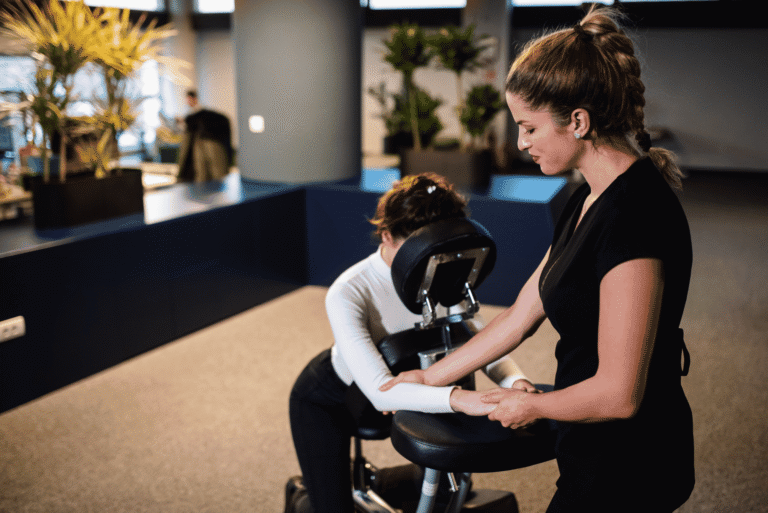
The session has to fit the workday, not interrupt it. This is especially true in Sydney offices where people may be moving between client meetings, hybrid workdays, secure floors, shared meeting rooms, and tight lift access. For many workplaces, seated massage works because it is quick and low-disruption. Corporate massage services can often be delivered at an employee’s desk or in a small meeting room, with short appointment lengths that help more people take part.
The practical question is not only “How many staff can we book?” It is “Can this run calmly?” A good provider will help you think through arrival time, room setup, booking flow, late arrivals, back-to-back sessions, and what staff need to know before the day. Experienced providers also have clear processes for managing unexpected disruptions, such as last-minute cancellations or no-shows, rescheduling sessions, and adjusting the schedule in the event of delays.
By proactively communicating changes and supporting on-the-day logistics, they minimise stress for HR teams and ensure the program runs smoothly even when plans need to adapt.
4. The right massage type for the setting
Not every team needs the same format. Chair massage is often the best fit for busy office days because employees remain clothed, no oils are used, and they can return to work quickly. Table massage may suit a quieter wellbeing room, longer appointments, or an event where relaxation is the main focus. For conferences and expos, the role of massage changes again.
It becomes part of the attendee experience, so flow, visibility, hygiene, and timing are just as important as the treatment itself. A good provider will not push one format for every setting. They will ask about your people, space, timing, event purpose, and likely uptake.
5. Supporting larger workplaces, conferences, and multi-site delivery
For larger organisations, workplace massage delivery becomes more than simply booking therapists for a day. Programs may need to work across multiple offices, rotating hybrid teams, conferences, secure corporate environments, or broader wellbeing initiatives running throughout the year. In these environments, consistency matters. Employees should receive the same professional experience regardless of location, team size, or event format.
At Holistic Services Group, we support organisations across Australia and Asia-Pacific with scalable workplace wellbeing delivery designed around operational realities. That includes practitioner quality standards, coordinated scheduling, clear communication with onsite contacts, and flexible delivery formats that minimise disruption to the workday. Whether the goal is a small office wellbeing activation, a conference engagement experience, or part of a broader workplace wellbeing strategy, the delivery process should feel calm, organised, and easy for both employees and internal teams.
6. Supporting employee wellbeing during high-pressure periods
KPMG’s Sydney Audit division booked seated workplace massage to support staff through a demanding reporting season. Sessions were scheduled in short, rotating blocks to minimise workflow disruption while still providing employees with practical recovery time during the workday. Post-session feedback was gathered through a short online survey sent to all participants. The majority reported reduced physical tension and improved mood. The sessions were rated among the most valued wellbeing initiatives the organisation had run that year.
7. Privacy and dignity for employees
Massage is personal, even when it happens at work. Employees should never feel watched, pressured, or expected to share health details publicly. Booking information also needs care. For workplace massage, this means keeping booking and participation simple, respectful, and limited to what is needed. A useful test is this: would a quieter employee, a senior leader, and a new starter all feel comfortable taking part? If the answer is no, the setup needs more thought.
8. Professional communication before and after
Good delivery starts before the therapist arrives. HR should know what space is needed, what staff should wear, how bookings will work, when the therapist will arrive, and who manages changes on the day. After the session, feedback helps you decide whether to repeat, adjust, or scale the program. The details staff usually remember are practical ones: Was it easy to book? Did the therapist arrive prepared? Did the session feel respectful? Did people return to work feeling settled rather than rushed?
Quick booking checklist
Before you book, ask:
- Are the therapists qualified, insured, and used to workplace settings?
- How will consent and staff comfort be managed?
- Can session times fit meetings, rosters, and hybrid attendance patterns?
- What setup is needed for the room, chair, access, and arrival?
- Which massage format best suits the goal of the session?
- How is booking information handled?
- Will feedback be gathered after the session?
- What happens if demand is higher than expected?
Choosing a provider in Sydney
Sydney workplaces are rarely simple. A provider may need to manage access to CBD, security sign-ins, shared meeting rooms, hybrid staff schedules, and teams spread across multiple sites. If you are planning a workplace massage in Sydney, look for a provider who can scale from a small office session to a larger wellbeing day without losing care, privacy, or structure. The right provider will not just ask when you want the massage. They will help you think through what will make staff feel safe enough to use it.
If you’re ready to plan a workplace massage program, consider how a tailored process creates the right experience.
A well-run workplace massage program should feel simple for employees and low-friction for internal teams. The right provider helps create a calm, professional experience that fits around real workplace demands, from small office wellbeing days through to conferences, wellbeing weeks, and national employee wellbeing initiatives. Holistic Services Group has supported Australian organisations since 2003 with workplace wellbeing programs designed for corporate, government, education, and hybrid work environments. Speak with our team about:
- Seated workplace massage programs
- Conference and event massage
- Multi-site wellbeing delivery
- Wellbeing week activations
- Ongoing workplace wellbeing programs
- Hybrid workforce wellbeing initiatives
Why organisations choose Holistic Services Group
- Supporting workplace wellbeing programs since 2003
- Trusted by organisations across Australia and Asia-Pacific
- Experienced in corporate, government, education, and conference environments
- National practitioner network with scalable delivery capability
- Flexible onsite and virtual wellbeing solutions
- Programs designed around operational realities, not generic wellness activities
FAQs
1. What qualifications should a corporate massage therapist have?
Look for therapists who hold at least a Certificate IV in Massage Therapy, but ideally a Diploma in Remedial Massage. Additionally, current first-aid certification, professional indemnity, and public liability insurance are required.
Membership with a professional body such as Massage & Myotherapy Australia provides an additional assurance of standards, as members are required to meet ongoing education, insurance, and conduct requirements. In workplace settings, qualifications alone are insufficient. Ask specifically whether therapists have experience managing short back-to-back sessions, professional boundaries in office environments, and varying comfort levels across different employees. A therapist who performs well in a clinic may still struggle in a busy corporate setting without that specific experience.
2. How long should workplace massage sessions be?
Session length depends on your team size, the program’s purpose, and how much time employees can realistically take away from their work. In busy office environments, 10- to 15-minute sessions are often the most practical. They allow more employees to participate without significantly disrupting the workday.
For dedicated wellbeing days or smaller teams, 20- to 30-minute sessions provide a more comprehensive treatment and a better recovery experience. A good provider will help you match session length to your headcount and available time, rather than applying a standard format regardless of context.
3. Is chair massage better than table massage at work?
For most office environments, chair massage is the more practical choice. Employees remain fully clothed, no oils are used, sessions are shorter, and people can return to their desks immediately, all of which reduces friction and increases participation. Chair massage can also be set up in a small meeting room or breakout space with minimal equipment, making it easier to run in CBD offices, secure corporate buildings, or environments with limited space.
Table massage is better suited to longer sessions, dedicated wellbeing rooms, or events where deeper relaxation is the explicit goal and employees have more time available. If you are unsure which format suits your workplace, a good provider will ask about your space, team size, session goals, and timing before making a recommendation.
4. What are the red flags when choosing a provider?
Be cautious if a provider cannot clearly explain therapist qualifications, insurance coverage, consent processes, privacy practices, or setup requirements. These are not complex questions, and a provider with genuine workplace experience should be able to answer them without hesitation.
Another red flag is a provider who cannot tell you what happens if staff demand exceeds availability on the day, or who leaves your internal team to manage logistics that should be the provider’s responsibility. Also, watch for providers who focus solely on relaxation benefits without acknowledging the professional and operational context of workplace delivery.
The right provider will ask as many questions as you do, because a well-run session depends on understanding your workplace, your people, and your goals before the therapist arrives.
5. Can corporate massage support workplace wellbeing?
Yes, when it is designed with care and positioned within a broader support framework. Workplace massage gives employees a practical physical recovery pause during the workday, reducing muscle tension, supporting circulation, and creating a visible signal that the organisation invests in its people.
A 2025 randomised controlled trial found that healthcare workers receiving short massage chair sessions several times a week showed measurable reductions in stress and depression symptoms, along with less musculoskeletal pain, within six sessions (Ong et al., 2025).
The strongest results come when massage is paired with broader initiatives, such as mental health workshops, ergonomic support, resilience programs, health expos, or wider wellbeing strategy planning rather than used as a standalone response to underlying workplace stress. Used in this way, massage contributes meaningfully to employee morale, engagement, and sustained performance.
6. How much space is needed for workplace massage?
Seated massage generally requires only a small meeting room, breakout area, or quiet office space. A professional provider should clearly explain the setup requirements before the day of the session.
7. How far in advance should workplace massage be booked?
Lead times vary depending on team size, timing, and location. Larger wellbeing days, conferences, and peak wellbeing campaign periods may require earlier planning to secure preferred dates and therapist availability. We recommend booking at least 2 weeks in advance for standard office programs and, if possible, 2 months in advance for June, September, October, and December, when demand is highest. For urgent requirements, contact us directly, as we can often accommodate shorter lead times.
8. How much does workplace massage cost?
Pricing for workplace massage is typically structured per session, per hour, or as packaged rates for larger groups or ongoing programs. This allows HR teams to plan and budget based on staff headcount and program duration. Please contact us for a detailed quote tailored to your needs.